 |  |
Allegations of drug smuggling
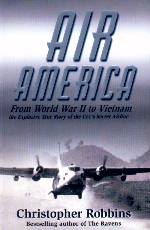
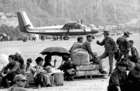
According to The Politics of Heroin in Southeast Asia, a 1972 study by historian Alfred W. McCoy, Air America transported opium and heroin on behalf of Hmong leader Vang Pao.[2] This allegation has been supported by former Laos CIA paramilitary Anthony Poshepny, former Air America pilots, and other people involved in the war. University of Georgia historian William M. Leary claims that this was done without the airline employees' direct knowledge and that the airline itself did not trade in drugs.
Cato
Institute, Halliburton CEO Dick Cheney
"The
good Lord didn't see fit to put oil and gas only where there are
democratically elected regimes friendly to the United States.
Occasionally we have to operate in places where, all things
considered, one would not normally choose to go. But, we go where the
business is."
June 23, 1998
George
W Bush - Oct. 3, 2000
"The
Vice President believes in nation building. I would be very careful
about using our troops as nation builders." He added that the US
military was already "overextended in too many places," and
ought to be used to "prevent war from happening in the first
place." In the same campaign, VP candidate Cheney says the US
stopped short of toppling Saddam Hussein, in 1991, so as to avoid
being "an imperialist power, willy-nilly moving into capitals in
that part of the world, taking down governments."
April 10,
2001
Aluminum
Tubes Lie
A report
containing research provided by a CIA analyst known only as Joe
reaches top Bush administration officials. It claims that aluminum
tubes being sought by Iraq are meant for uranium centrifuges. The
assessment is immediately challenged by the Energy Department, which
builds centrifuges and runs the government's nuclear weapons
programs. The New York Times in 2004 will report, "The next day,
Energy Department officials ticked off a long list of reasons why the
tubes did not appear well suited for centrifuges. Simply put, the
analysis concluded that the tubes were the wrong sizetoo narrow, too
heavy, too longto be of much practical use in a centrifuge."
Mother
Jones
By DAVID
BARSTOW, WILLIAM J. BROAD and JEFF GERTH
In 2002, at a crucial
juncture on the path to war, senior members of the Bush
administration gave a series of speeches and interviews in which they
asserted that Saddam Hussein was rebuilding his nuclear weapons
program. Speaking to a group of Wyoming Republicans in September,
Vice President Dick
Cheney said the United
States now had "irrefutable evidence" - thousands of tubes
made of high-strength aluminum, tubes that the Bush administration
said were destined for clandestine Iraqi uranium centrifuges, before
some were seized at the behest of the United States.
Those
tubes became a critical exhibit in the administration's brief against
Iraq. As the only physical evidence the United States could brandish
of Mr. Hussein's revived nuclear ambitions, they gave credibility to
the apocalyptic imagery invoked by President Bush and his advisers.
The tubes were "only really suited for nuclear weapons
programs," Condoleezza
Rice, the president's
national security adviser, explained on CNN on Sept. 8, 2002. "We
don't want the smoking gun to be a mushroom cloud."
New
York Times
Get $250 Worth Of Free Groceries
http://www.getgroceryfree.com/?gclid=CMLitfnuhZoCFSAhDQodXXdyFw
Bush
and Blair made secret pact for Iraq war
Faced
with this prospect of a further war, he adds, Blair 'said nothing to
demur'.
Details of this extraordinary conversation will be
published this week in a 25,000-word article on the path to war with
Iraq in the May issue of the American magazine Vanity Fair. It
provides new corroboration of the claims made last month in a book by
Bush's former counter-terrorism chief, Richard Clarke, that Bush was
'obsessed' with Iraq as his principal target after 9/11.
The
Guardian
I Love Free Things
http://www.ilovefreethings.com/?gclid=CIrf65_vhZoCFRIeDQodxkmLFw
January 30,
2001
Bush
"From
the very beginning, there was a conviction that Saddam Hussein was a
bad person and that he needed to go." Saddam's removal is the
first item of Bush's inaugural national security meeting.
Then-Treasury Secretary Paul O'Neill later tells journalist Ron
Suskind, "It was all about finding a way to do it. That was the
tone of it. The president saying, 'Go find me a way to do
this.'"
Bush also says the emphasis on Iraq will accompany a
de-emphasis on the Israeli-Palestinian conflict. Secretary of State
Colin Powell says US disengagement would give Ariel Sharon free rein
and bring further suffering upon the Palestinians. According to
Suskind's later book, "The One Percent Doctrine," Bush
replies, "Sometimes a show of force by one side can really
clarify things."
Mother
Jones
Miami's
rent-a-riot
"But
the fact is that the fracas at Miami's recount headquarters was
engineered and carried out by Republican Party operatives imported
from the heartland, far from South Florida. They might have reminded
viewers of Eli�n's Army -- and might even have taken lessons from
the Cubans -- but, by all accounts, the city's strident conservative
exile community was very much in the minority. As one observer put
it: "There were no guayaberas. This crowd looked tweedy. They
were from out of town salon.com
Shop 4 Freebies Cedar Fres
http://www.shop4freebies.com/ http://www.cedarfresh.com/form/contact.php
 |  |
